

Look, I’ll just say it. Most AI automation projects for small businesses are a waste of money. Do you know why?
You don’t need a neural network to send an email. You just don’t. But paying someone an hour to copy-paste customer names from a inbox into a spreadsheet? That is a different story. You are bleeding cash for no reason. You know that right? If don’t i’ll guide you in this post setp by setp and at end you have all the info that is AI automation worth it for your small business. By the way at Stackians, we build these systems every day. So, if you dont have time to read all this or get in to issues like these:
- The companies that see actual ROI never try to automate everything at once.
- They pick one annoying bottleneck (do you know that bottleneck? if not contact us to help to fond that), fix it, and watch it.
- Companies that get burned usually try automating four messy processes at once, right before realizing nobody on their team even agrees on step two or dont keep the human loop which is the most important process until you tested it in products for more then 15 days.
McKinsey’s research showed that fewer than four out of ten businesses buying AI tools ever see a dime of actual profit. 61% are just throwing money at software subscriptions. Goldman Sachs saw the exact same disconnect: 76% of small businesses use AI tools in some form, but only 14% have integrated automated workflows into core operations. I know these number that you can’t verify just added for referene for you. That gap between playing with ChatGPT and running a background workflow that saves ten to twelve hours a week is where most business owners get stuck.
Let’s strip away the hype. Here is what automation actually costs, when the math works, and when you should walk away.
What I’m Actually Talking About
I’m talking about software that runs on strict rules. A lead goes cold, a follow-up text fires. An appointment is booked, a reminder goes out two hours prior. A customer asks a pricing question, a chatbot answers. It isn’t a robot running your business. If your sales process sucks, an automated workflow just helps you lose leads at scale.
Automation runs at 2am on Sunday. It doesn’t get tired or ask for time off. It is terrible with messy data. Anything requiring human empathy or complex negotiation still takes an actual person sitting in the chair. Closing a complex deal takes a human every time.
Where business owners mess up is trying to automate relationships instead of administrative tasks. The tech works fine. The strategy is broken. Guess what just kidding its up to you will you choose us or anyone else this post help you is AI automation worth it for small business or not.
The Honest Numbers on ROI
Back to that 61% failure rate. It is the majority.
We audit client systems constantly. The pattern is always the same. Someone spent three thousand dollars automating a task that happens four times a month. Insane right? Or the incoming data is a total disaster, like a CRM full of typos and duplicates or halucinated data.
The automation runs fine, but it spits out garbage at lightspeed (like yours bank account debit thousand of dollars) Or nobody monitors the system, an API endpoint changes, and the workflow quietly dies for three weeks. We saw a roofing contractor lose qualified leads over Labor Day weekend because a webhook broke and nobody checked the logs.
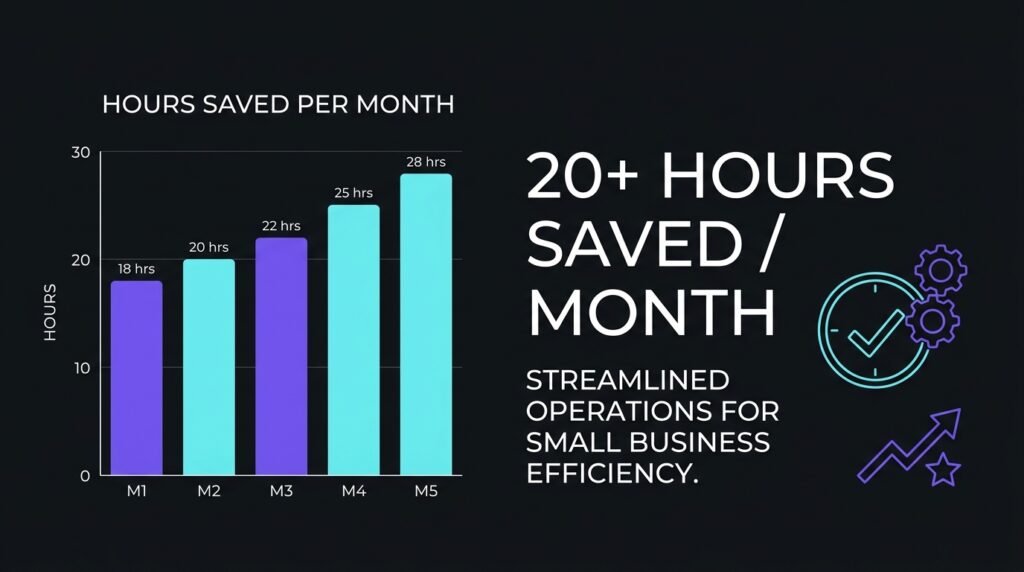
The successful 39% do one thing. They pick one high-volume process. They fix it. Then they move on. A survey found 58% of small businesses save over 20 hours a month this way. The tools are identical. The difference is starting narrow.
Where the Fastest Returns Actually Come From
Here is where we see actual ROI at Stackians. (promotion is compulsory)
Someone fills out a form at 11pm on Friday. By the time your office opens Monday morning, that lead has already booked a call with someone else. Harvard Business Review data confirms that responding in under five minutes boosts your odds of landing a real conversation sevenfold. An automated text firing two minutes after submission fixes this. We build this in GoHighLevel all the time. The revenue impact hits immediately.
No-shows bleed money. Empty calendar slots cost you the appointment fee, your staff’s wasted prep hours, and the patient you had to turn away. Setting up automated SMS confirmations (one a day before, one two hours out) sliced empty slots by 40% for an Austin dental practice we work with, adding $4,200 straight to their bottom line in week three.
Stop paying humans to copy-paste. Shuffling addresses from a web form into a CRM and then into QuickBooks is a mechanical rule. It wastes human brains. We helped an estate law firm cut 14 hours a week from their billing by putting a background integration between their intake forms and billing software in place. That was 14 hours returned directly to billable client work.
Support eats your team alive. A basic chatbot handling your 15 most common questions frees your staff for real conversations. Pricing. Hours. Booking links. Automate them. A marketing agency we worked with dropped their weekly admin email volume from 35 hours to 8 hours. They got 27 hours back every single week.
You must be think how? read more to know how we did it and you can do it as well?
When It Is Not Worth It
Automation isn’t for everyone. We turn down projects that won’t make money.
Low volume breaks the math. If you get three leads a week, pick up your phone and text them manually. The math only shifts around 25 to 30 repetitions a month. Below that threshold, setting up the system takes longer than doing the work manually.
Automations run on strict rules. If your process changes every two weeks, you will spend your life paying developers to fix broken logic. Map the process until it is stable for ninety days. Then build.
Disorganized data is a brick wall. If your customer records live in four spreadsheets and a messy Gmail inbox, fix your data first. Clean data goes in, clean automation comes out.
Look at the 2024 Air Canada case. Their customer service chatbot hallucinated a refund policy. A passenger relied on it, and the court held Air Canada legally responsible for what the bot said. Unmonitored automation creates legal liability.
Which Tool Should You Use?
It depends on your scale.
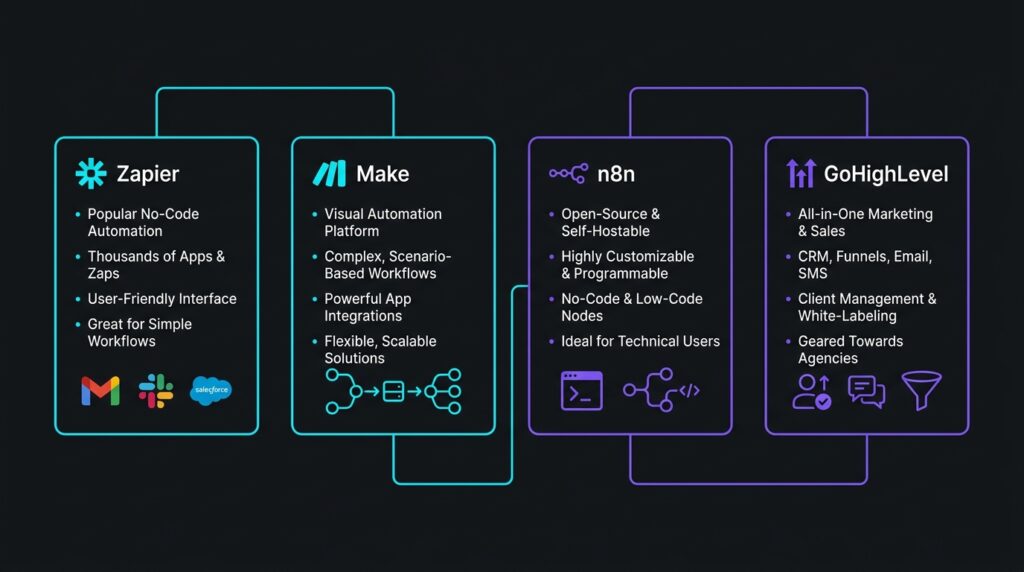
Zapier is the easiest start. It connects to 9,000 apps without code. The catch is cost. Zapier charges per task. At volume, it gets brutally expensive.
Make handles complex branching logic at roughly one-fifth the cost of Zapier. Once you hit cost ceilings on Zapier, move to Make.
We recommend n8n for serious scale. It is open source and self-hostable. A business running heavy volume might pay $350 a month on Zapier. That same volume on self-hosted n8n costs $15 a month for server hosting. The catch is needing a developer or an agency like Stackians to maintain the server.
GoHighLevel is different. It is a CRM, email system, calendar scheduler, and automation engine in one. For local service businesses, it replaces four separate subscriptions.
Three Questions For You
Ask these three questions first:
- Is it high-volume? Less than 30 times a month? Do it manually.
- Is it predictable? Can you write down the exact rules with zero exceptions? If not, you can’t automate it yet.
- Who will monitor it? Businesses skip this. APIs change. Tokens expire. A perfect workflow breaks six months later with no alert. Someone must check the logs.
If any answer is no, fix the gap first. If you have any questions, do let us know.
What Realistic ROI Actually Looks Like
A real calculation. A $22/hour employee spends eight hours a week to copy lead data, send follow-up texts, and confirm appointments. That is $176 a week, or $760 a month spent on robotic work.
An agency setup for those workflows costs $800 to $1,200. Tool hosting is maybe $10 a month. You save $760 in labor. You get payback in less than two months. Everything after that is net positive.
That makes sense. Two hours a week? Doesn’t make sense. Shifting processes? Doesn’t make sense.
The numbers don’t lie. The real challenge is sitting down and looking at how many times your team actually runs that manual step every week.
The Bottom Line
Now you know which tools you need to choose, what rules you need to follow and now you can tell me is AI automation worth it for small business or not?
Pick your most annoying manual task. Map the rules. Build the automation. Watch it. Fix it. Move on. Failures happen when teams automate broken processes, feed dirty data into pipelines, or fail to check logs.
Want a straightforward, zero-fluff assessment of your business operations? We offer a free 30-minute strategy call with our experts. No pitch, no slides. We look at what your team does manually, tell you what is automatable today, and tell you what isn’t ready. That’s it.
FAQ’s to Common Automation Questions
Initial setup usually lands between $800 and $2,500 depending on how messy your current workflows are or we need to start from scratch. Platform hosting for n8n runs $10 to $25 a month, and most of our clients break even within ninety days.
Instant SMS lead follow-ups, calendar reminders, basic intake chatbots, and pushing web form submissions straight into your billing platform.
Not at all. Day-to-day operations don’t require an engineer on payroll in evey case someone on your team just needs ten minutes on Friday to scan the system error logs.
Zapier requires zero technical skills but gets expensive fast. Make handles complex branching at a fraction of the cost. n8n is open source and cheapest at scale, but requires technical server setup.
No. It eliminates administrative drudgery so your team can focus on sales, relationships, and real client work.
A focused first project takes two to three weeks. Trying to build five workflows at once takes four months and usually fails.
Published by Stackians, a web development and AI automation agency for growing businesses. See our AI automation services.